
The history of Middle River Station, and its evolution from a quiet railroad junction into a localized community hub, is grounded in the lifelong research of Baltimore County historian John McGrain. His work preserved the personal stories of the families who lived and worked near the rail lines.
This is the story of how a simple railroad switch helped shape Middle River:
The Yacht Club and Eleven Mile Switch (1875)
Before it became a regular passenger stop, the area was simply a quiet railroad switch on the Philadelphia, Wilmington, and Baltimore Railroad (PW&B) known to conductors as “Eleven Mile Switch”.
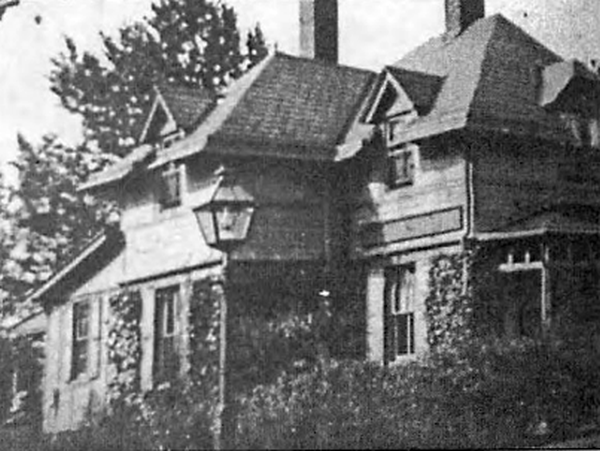
The first major shift occurred in the summer of 1875. On July 3, The Baltimore Sun reported that a contractor named Archibald Teal was constructing a new, 45 x 50-foot clubhouse for the Maryland Yacht Club at Clark Point. To help city members reach the club, the PW&B Railroad erected a small passenger station at the switch. Within two years, local atlases officially designated the stop as “Middle River Station”.
William Louis Smith’s Hotel (1892)
Seeing an opportunity in the new railroad stop, a local entrepreneur named William Louis Smith decided to build a future for his family there. In 1892, he built a seven-room hotel on the west side of the tracks, directly across from the station.
Smith’s daughter, Edith Smith Asher, later recalled that her mother was initially dismayed by the move, upset at the prospect of leaving Anne Arundel County for “that wilderness of farms and swamps”. However, Smith’s gamble paid off. While his plans to establish a surrounding commuter suburb called “Middleton” did not immediately materialize, the hotel became a popular destination for fishermen and hunters. On weekends, the rooms filled to capacity, with the hotel serving up 50-cent chicken dinners to travelers heading back to the station with their weekend catches.
Life in a “Five-Family” Town
At the turn of the century, the settlement around the station remained small, with only about five families living in the immediate vicinity. The community revolved around a few key landmarks and figures:
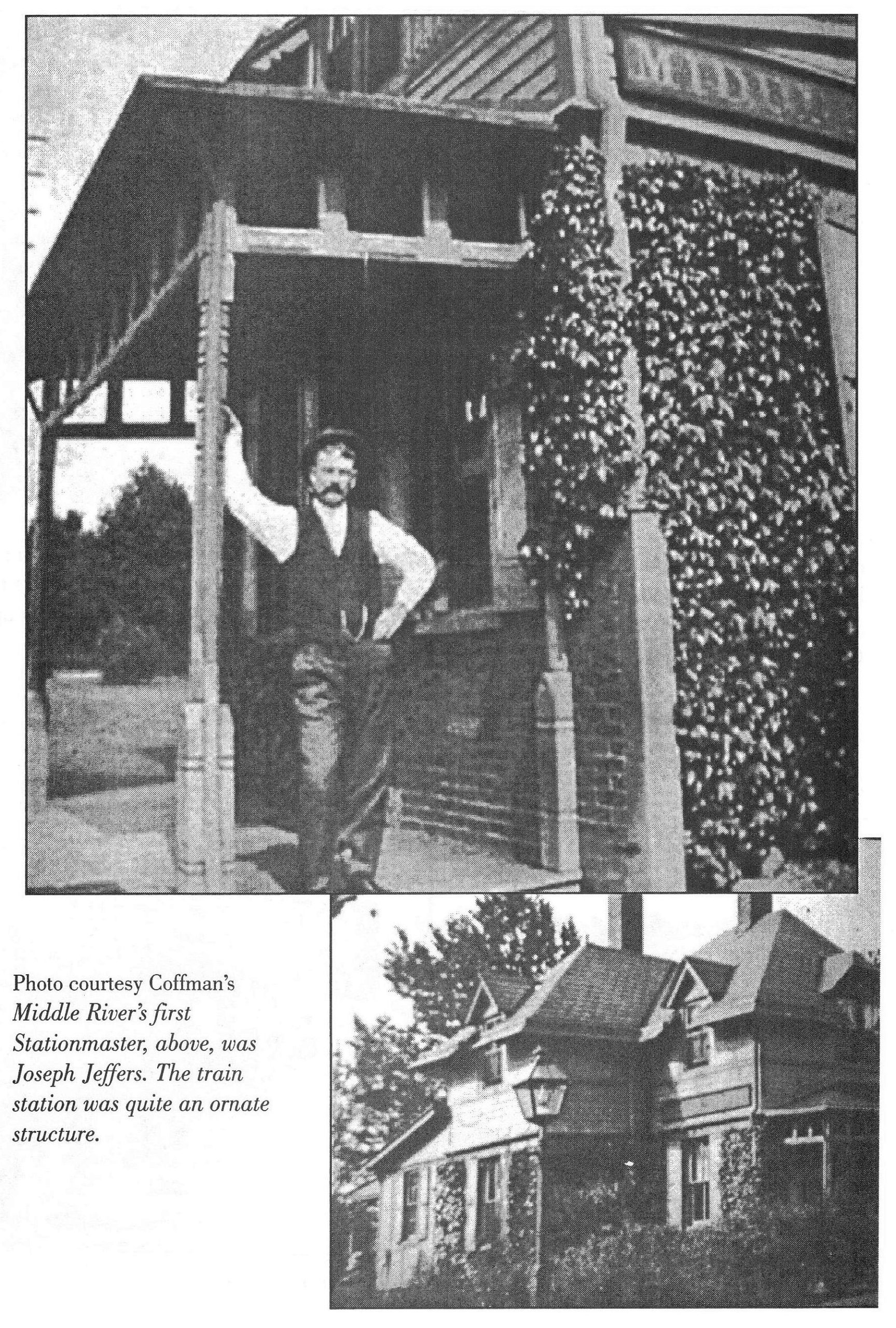
- The Stationmaster: Joseph Jeffers served as the stationmaster during these early years. Locals remembered steam trains slowing down just enough as they approached the platform to snag mail bags hanging from a trackside hook.
- The Post Office: William Louis Smith operated the Middle River Post Office directly from his hotel. A dedicated post office was built near the tracks in 1896, with John Hughes serving as the postmaster.
- Local Businesses: Residents relied on Mrs. Kimmel’s small grocery store just south of the tracks and Heldorfer’s Saloon on Wampler Road.
- The Only Phone: For emergencies or outside contact, residents walked to the home of Dr. John Harrison (located at the present-day intersection of Eastern Avenue and Harrison Avenue), who owned the only telephone in the area.
The Siding Expansion (1917)
The rural character of the station changed permanently in 1917. To accommodate growing freight traffic and industrial needs, the railroad company purchased and demolished Smith’s hotel to expand its local siding. This secondary track served as a low-speed branch off the main line, allowing freight cars to be parked, loaded, and unloaded without blocking the main passenger lines.
While the physical hotel was lost to the expanding railroad, the early history of the station remains preserved through family memoirs and John McGrain’s research papers. His meticulous archival work—which is honored today through the Preservation Alliance’s prestigious John McGrain Lifetime Achievement Award in Historic Preservation—ensures that the stories of old Middle River continue to be told.
Sources & Historical References
- Historical Text: McGrain, John. (1996). Middle River Background (Breihan Project).
- Secondary Source Text: Nickel, Jackie. (2002). Memories of Old Middle River.
- Primary Source Materials: The Baltimore Sun (July 3, 1875); G.M. Hopkins Atlas (1877); Edith Smith Asher, “I Remember Middle River as a 5-Family ‘Town’,” Sun Magazine (November 28, 1954).
Museum photos and clippings come from the Heritage Society Baumgartner Archives and other sources, scanned by Rita Gaunt, museum photos by Sue Carter and additional research by archivist Scott Huffines.
This print archive captures a historical snapshot of life in Essex and Middle River, Maryland. The archive contains nearly 300 categorical binders documenting our community activities with articles, pamphlets, and photographs from 1969 through the 1980s. The Heritage Society has been scanning the collection to our website to share with our extended community.
As we continue to build new collections, we are seeking new materials such as photographs and ephemera that pertain to the community and business history of Essex and Middle River. Please contact essexmuseum@gmail.com if you have historical memories or items to donate or would like to become a member.
Read more about the Heritage Society Baumgartner Archives.